
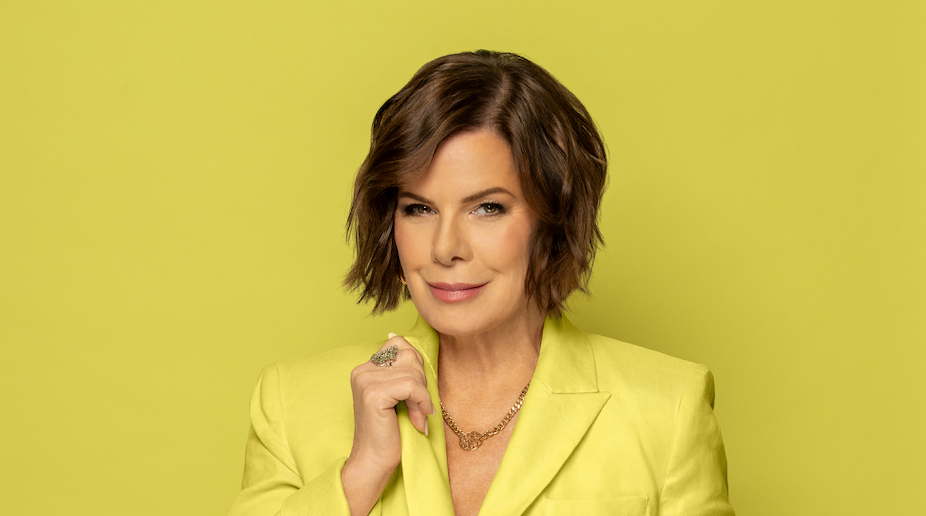
On a late fall day, in an elegant hotel suite high above the streets of downtown Toronto, Marcia Gay Harden is giving a clinic in how to pose for a magazine cover. Standing in front of a bright-green backdrop, she patiently, expertly follows the photographer’s directions in striking a variety of poses, a shoulder angle here, a hand to the chin there, with multiple wardrobe changes along the way. As it concludes, hundreds of shots later, she motions to the whole crew, the makeup and hair people, even the writer sitting off to the side.
“Now everyone come in for a selfie!”
Harden is no stranger to photo shoots. A cursory online search turns up endless images of the acclaimed actor, on red carpets, at charity events, and most notably posing with the Oscar® she won in 2001. This was something different. She was not promoting a movie or doing an entertainment magazine interview. Harden was appearing on the cover of Mind Over Matter®, thinking all the time about her mother, Beverly, who died of Alzheimer’s disease in 2018.
“I come to the magazine more as a daughter, rather than a celebrity helping herself. This is really about representing my mom and representing many people with Alzheimer’s who can’t represent themselves,” she said in a conversation after the photo session.
Harden was in Toronto to participate in the first Women’s Brain Health Summit, organized by Women’s Brain Health Initiative (WBHI). She joined an impressive array of celebrities, scientists, and people touched by dementia to speak to a sold-out room about her experience as a caregiver (along with her siblings) for her mother.
It’s a downhill journey. So, the joy that you have to find is in the love that you have for the person.
“You will eventually lose them, but there’s a light that cannot be extinguished, like my mother had. Elegance and kindness and her beautiful eyes. You just knew that there was a soul still in there that couldn’t express itself,” she continued.
In a speech that was at times both hilarious and heartbreaking, she told the Summit the story of her final Thanksgiving with her mother, when she brought her three children to visit Beverly at her home in Texas.
“Even though my mom was a shadow of her former self, I really wanted my kids to just be with her. She was in a wheelchair now and when we first got there, she was super confused. If I’m truthful, there were a few awkward pauses as they navigated their and her distress.”
As she showed pictures from the memorable visit, Harden recounted how her mother gradually opened up a bit and by the end of the day, was able to crack a joke, pose with the family in goofy party hats, and give love advice to Marcia’s eldest daughter, Eulala. Beverly passed away two weeks later.
“We’ll always have the memory of her just laughing, and her crown,” she said, adding an essential lesson for other caregivers.
“All we can do is cherish them with dignity and with love. My kids helped me with my mom. And I guarantee that they are afraid for me, and they are afraid for themselves because no one wants this disease. But if God forbid anything were to happen to me, they’ll be able to handle my care with love and humour.”
Harden told Mind Over Matter® that the experience prompted her to give clear directions to her children.
“I said to my kids, ‘Don’t feel like you have to take care of me. Once I can’t remember, you know, night from day and you from Adam, let experts take care of me.’ Believe me, I’m not manifesting this disease, I don’t want it, but I think those conversations are really important to have with your kids.”
Harden was determined that her mom should not be remembered only for the disease that took her, and so she wrote a book: The Seasons of My Mother: A Memoir of Love, Family, and Flowers, as a fond tribute. She has also carved out time from a busy acting career to speak regularly about Alzheimer’s, including at WBHI events.
“I feel that the dialogue around dementia and brain health has changed drastically in the past 15 years. And that’s as a result of people speaking up, from (WBHI Founder and President) Lynn Posluns, to Maria Shriver (Founder of the Women’s Alzheimer’s Movement) and the Alzheimer’s Association,” she said.
THE EXPERIENCE OF ALZHEIMER’S IS SHADOWY ENOUGH ALREADY. WE WANT TO SHINE AS MUCH LIGHT ON IT AS WE CAN. FAMILIES ARE OVERWHELMED AND IT HAS AN ELEMENT OF SHAME AND DARKNESS. TO SPEAK OUT HELPS GET RID OF IT.
In her talk to the Summit, Harden drew parallels with the response of the gay community in New York City to the AIDS epidemic in the 1990s, a time when she was starring on Broadway in Angels in America, a play that brilliantly explored the societal issues around the disease.
“I was super inspired by the gay community, how they galvanized and came together to make the medicines more affordable, to learn how to live with it, and how to care for each other. They were advocates for themselves. I think at times it is tougher (for people with dementia) because they can’t speak for themselves.”
Now, she is using her voice to advocate for them. “It was such an honour to be here. Thank God for WBHI, because Lynn’s mission is to put money into women’s brain research.”
Harden found the scientific presentations at the summit fascinating, particularly the statistical evidence about the prevalence of dementia among women and the relative lack of research into differences between the sexes, a disparity that is closing, thanks to the advocacy of organizations like WBHI.
“So much research has not been done on women’s brains, exploring the effects of hormones or menopause or early years. It’s not OK. I’m thankful we have great scientists at work right now trying to figure out why this happens.”
Over the years she has learned more about how to nurture brain health through healthy lifestyle choices and now tries to control her sweet tooth, noting with a smile that she slipped a bit with the pastry she was nibbling on during the interview.
“You learn about exercise, you learn stress, you learn to sleep, I became obsessed with sleep. I was definitely the girl who thought five hours is amazing. I often was getting only three hours at a time. So, I changed that to try to get at least seven and a half.”
Harden is also grateful that her work constantly brings her in contact with people, with fresh ideas, new creative endeavours, and stimulating social interaction. “My mother had a huge sense of community, too. All of her life she was very creative, very active, very artistic, and she had five kids around into her old age.”
ONE OF THE THINGS ABOUT ALZHEIMER’S IS MY MOTHER SHOULD HAVE BEEN THE POSTER CHILD FOR SOMEONE WHO SHOULDN’T GET IT.
One of Harden’s newer projects is a podcast she hosts called Snoriezzz, in which she reads bedtime stories for kids, with gentle messages of self-affirmation. This from someone who says she was tough on herself as a kid.
“Those things make a difference on the brain. They make a difference on how you sleep that night, and they make a difference on how you are the next day.”
Beverly Harden lived long enough to see her daughter win fame, critical acclaim, and awards, but her memory was already fading when Marcia started to speak out about dementia.
“I think she would be proud, but she would also think, ‘Why would anybody want to talk about me?’ She was very humble. You know, the last great act my mother did was to donate her brain to Alzheimer’s research. And that was huge. She made that decision when she was still cognitive, when we first understood that she had Alzheimer’s. She knew that that was the one thing she could do.”
Source: Mind Over Matter 22