
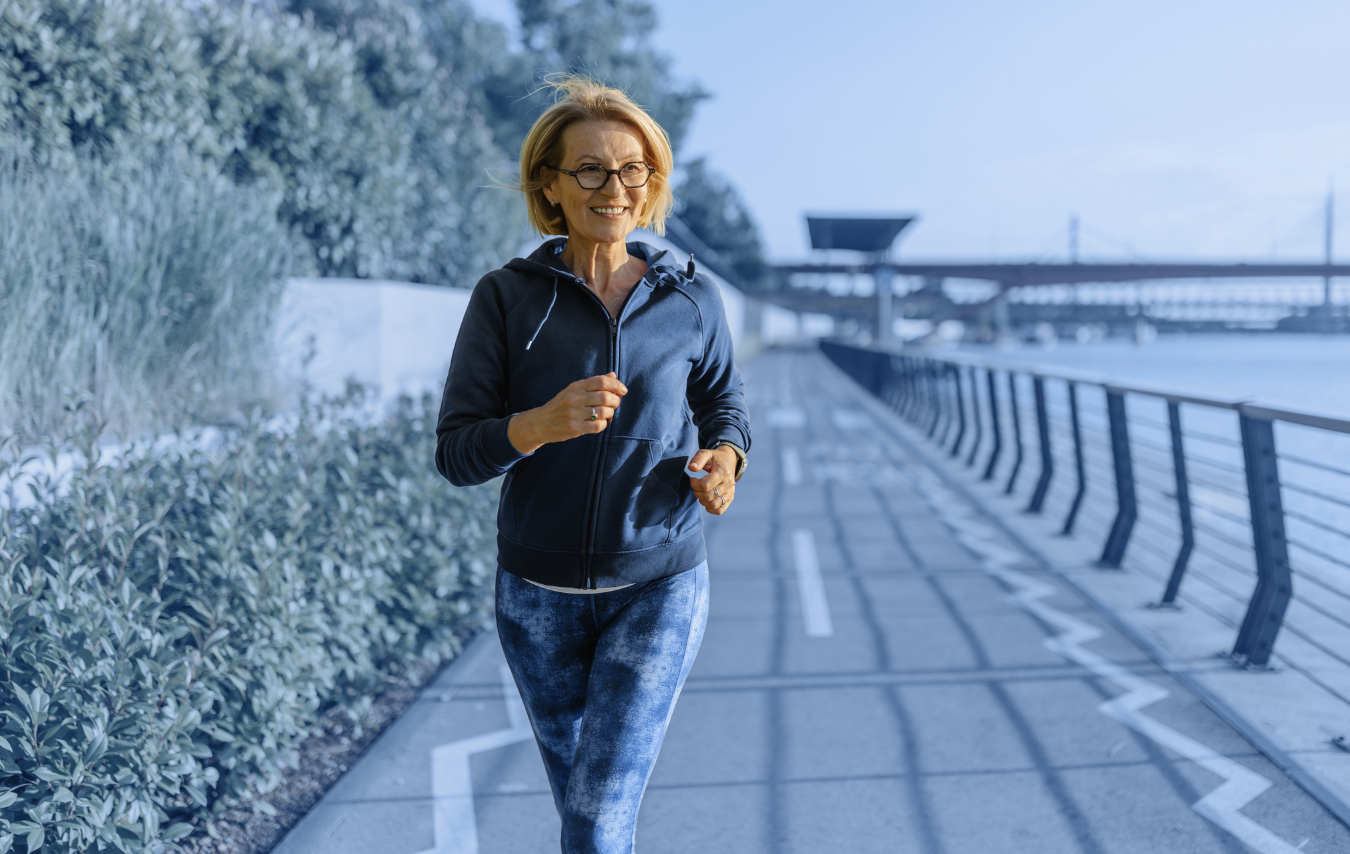
‘Japanese Walking’ Can Boost Longevity & Brain Health.
Ever since the “daily constitutional” of Victorian times, women have known that walking puts a spring in our step. But here in the 21st century, a rigorous method developed in Japan has transformed this everyday activity into a longevity powerhouse that improves Type 2 diabetes, body-weight composition, high blood pressure, and even brain function.
Known as ‘Japanese walking,’ the method involves short bouts of exertion alternating with the kind of strolling that doesn’t make us break a sweat.
Essentially, it’s a form of interval training, except this approach is gentle on ligaments and joints, and its benefits have been documented particularly in older adults.
The method originated in a 2007 study from Shinshu University in Japan, where researchers refer to it as “interval walking training.” But on social media, the label “Japanese walking” has caught on, boosted in part by the island nation’s reputation for longevity.
Dr. Shizue Masuki, a professor in the Department of Sports Medical Sciences at Shinshu University, said she welcomes the nickname for the method she and her colleagues developed. “We are very proud of the term ‘Japanese walking,’ based on our research,” she said.
BETTER BLOOD PRESSURE, HEALTHIER KNEES
In the original 2007 study, published in Mayo Clinic Proceedings, Japanese adults in their late 50s to late 60s were instructed to walk for three minutes at a leisurely pace, slow enough to keep up a conversation, followed by three minutes at a pace fast enough to make it difficult to talk.
Participants repeated these intervals for at least five sets in each workout, performing the routine four or more days a week. A second group maintained a moderate continuous walking pace for at least 8,000 steps, four or more days per week. The third group had no walking routine.
Five months later, the interval walkers had better knee extension and flexion forces than the other two groups. What’s more, their aerobic capacity and systolic blood pressure numbers improved.
The results supported a new strategy to “get older people fit,” noted Dr. Martin Gibala, a professor of kinesiology at McMaster University.
The upside of a walking-based program is it’s accessible, it doesn’t require specialized equipment, and it doesn’t require a lot of training to do.
Dr. Masuki and colleagues continued to study interval walking in older adults, measuring factors including VO2 max, the maximum rate at which the body can use oxygen. Based on the original report combined with a 2011 study published in British Journal of Sports Medicine, interval walking increased VO2 max in older adults by 10% to 15%, Dr. Masuki said. “This is very important,” she explained, because “VO2 [max] is a strong and independent predictor of all-cause mortality.”
BRAIN BOOST
Interval walking can sharpen our mental faculties as well. In a 2020 Canadian study published in Applied Physiology, Nutrition and Metabolism, high-intensity interval walking led to significant improvements in the ability to remember everyday items. This ability allows us, for example, to identify a specific vehicle in a parking lot full of nearly identical cars, or to remember if we took our last dose of medication yesterday or today.
Researchers refer to this cognitive skill as “high-interference memory,” since our brain must focus on new information despite interference from older, competing memories. This subtype of memory is particularly vulnerable to age-related changes, the study authors wrote. Fortunately, it is also highly responsive to high-intensity interval walking.
Of the participants, aged 60 to 88, 61% were female and all were healthy but sedentary at the start of the study. Some began interval walking on a treadmill three times a week, others did treadmill walking at a moderate pace three times a week, and the third group limited their exercise to thrice-weekly classes of stretching.
To assess memory, participants were shown computer images of familiar objects, such as apples or cars, and asked to click different buttons to indicate if they’d already seen the image in the test, had never seen it, or if the image was similar to one previously shown. The images that were similar but not identical (such as apples of different colours) put their high-interference memory to the test.
After three months, adults in the high-intensity interval group showed average improvements of up to about 30% on the memory test. But the same memory skills, on average, did not improve in walkers assigned to a continuous moderate pace, or in the stretching group.
Researchers also assessed their executive function – the set of cognitive skills needed to plan, organize, and follow through with tasks. Here, exercise intensity seemed to matter less, since both the high-intensity and moderate-continuous walking groups showed a trend toward improvement.
The modest gains in executive function, however, were not as pronounced as the memory gains observed in the high-intensity interval group.
BLOOD-SUGAR CONTROL & VISCERAL FAT
Other researchers looked at the effects of interval walking on obesity and diabetes, both of which cause chronic inflammation and have negative impacts on brain health.
A 2013 study published in Diabetes Care monitored adults with an average age of 60, all of whom had Type 2 diabetes and were either overweight or obese. A third participated in an hour of interval walking five days a week, another third did about the same amount of moderate continuous walking, and the rest followed no exercise routine.
After four months, the interval walking group showed significant improvements in cardiovascular fitness and lost an average of 4.3 kilograms (9.5 pounds), including visceral fat around their internal organs.
They also showed better blood-glucose control, noted the study’s lead author, Dr. Kristian Karstoft, a medical doctor and clinical associate professor in the Department of Clinical Medicine at the University of Copenhagen.These improvements in blood-glucose levels were roughly equivalent to “what you would see with one glucose medication, for instance, metformin,” he said.
In contrast, the moderate continuous walking group showed no significant change in their cardiovascular fitness, body mass composition, or blood-glucose control.
The results are striking considering that both walking groups logged the same total hours of exercise, and both achieved an average exercise intensity of about 66% of their peak heart rate. The crucial difference: the interval walking group varied their pace, reaching a mean of 89% of their peak energy expenditure during fast intervals and 54% during slow intervals, equivalent on a graph to gentle hills and valleys.
THESE ALTERATIONS IN ENERGY EXPENDITURE WERE ENOUGH TO IMPROVE THEIR PHYSICAL FITNESS, SHED VISCERAL FAT, AND LOWER THEIR BLOOD-GLUCOSE LEVELS.
How long does it take for interval walking to pay off? “In terms of physical fitness,” Dr. Karstoft said, “we typically see improvements after one month.”
Glucose control improves after a single bout of exercise, whereas weight loss can take two or three months. In the short term, he said, individuals might even see a temporary increase in water weight, since our bodies adapt to exercise by generating more blood to transport oxygen through the body. People should be informed about this temporary water weight gain, Dr. Karstoft pointed out, “because they’ll get discouraged if they don’t know about it.”
He added that interval walking is generally safe for older adults, but before starting the program, individuals should consult a doctor if they have nerve damage in their feet from chronic diabetes, or a severe and unstable heart condition. “Otherwise, there are no general contraindications for this.”
However, there is one more caveat: interval walking may not be intense enough to benefit people who are already physically active. As a rule of thumb, Dr. Karstoft said, “individuals who are able to run continuously for ten or 15 minutes would probably not be a good fit for this intervention.”
HOW TO STICK WITH IT
Unfortunately, those who might benefit most from interval walking, including sedentary adults who are overweight or diabetic, tend to abandon the routine after a few months, according to a 2024 review published in Applied Physiology, Nutrition, and Metabolism.
The review found that after the initial 12-week study period, Danish adults’ participation dropped to about nine minutes a week, despite motivational phone calls from researchers and support from an electronic app. In Japanese research, participation also declined over time.
The review authors attributed these declines to varying comfort levels with the electronic devices used in the studies, and to a potential “lack of integration” between interval walking and participants’ day-to-day lives.
To encourage more people to stick with it, Dr. Masuki and colleagues have developed an easy-to-use smartphone app for interval walking training. Although this service is currently only available in Japanese, Dr. Masuki said, “we will make it usable worldwide in the future.”
Exercise-tracking apps can be very motivating for some people, said Dr. Gibala at McMaster University. But he emphasized that interval training can still be effective even if the regimen is not strictly followed. As long as the activity includes bouts of high intensity, he said, “the protocols don’t really matter.” For example, someone walking their dog at night could pick up the pace for the distance between three streetlamps and then slow down for the next lamp post or two.
Dr. Gibala added that physical activity doesn’t have to mean traditional structured exercise.
Adults who are strapped for time can focus on incorporating brief periods of vigorous activity as part of daily life, such as walking up a flight of stairs with a heavy backpack.
Accumulating four minutes a day of vigorous physical activity, Dr. Gibala explained, is associated with a 25% to 30% reduction in all-cause mortality. The key is to make our hearts beat faster. As long as we’re exerting ourselves, he said, “pickleball counts. Ballroom dancing counts.”
Source: Mind Over Matter 22