
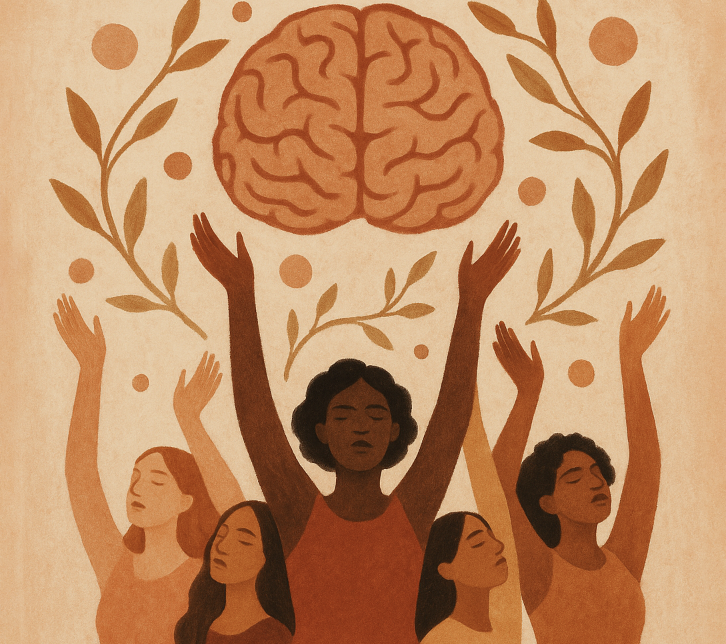
With Dr. Gillian Einstein.
On a mild spring evening in Toronto, Lauralyn Johnston stepped to the podium to speak to a small crowd in the atrium of Toronto’s Princess Margaret Cancer Centre. Beside her, on a tall sheet of paper, was a sketched outline of a woman’s body, arms upraised. At thigh level was a caption: “Please. I am not a gene.”
While Lauralyn does not claim to be an artist, this was her work; not a self-portrait, but a “body map.”
“I learned that I had the family curse, BRCA 1, in 2017, and that my father’s cancer, like his mother’s before him, was genetic,” she told the audience. “I am a previvor.”
Previvor is an esoteric word for most, but full of profound implications for those to whom it applies, including Lauralyn. It is defined as someone who is a survivor of a predisposition to cancer.
BRCA is a genetic mutation that can increase the risk of ovarian and breast cancers, a prospect that prompts some women, including Lauralyn, to make the momentous choice of having their ovaries and fallopian tubes removed in a procedure called a bilateral salpingo-oophorectomy (BSO).
“This body mapping exercise was, for me, a very powerful way to think about my personal adaptations to a new normal,” said Lauralyn. Her body map showed bubbles floating out of the head, a representation of how her memories have become more elusive since the BSO.
THE PROCEDURE CAUSES ESTROGEN LEVELS TO PLUMMET AND INDUCES MENOPAUSE. THERE IS RESEARCH INDICATING THAT IT CAN HAVE AN IMPACT ON COGNITIVE DECLINE.
Displayed throughout the atrium were 13 body maps created by other women who were telling the story of their memory and BSO experience in an exhibition titled “‘Life outweighs risk’: Maps of memory and resilience in women with cancer risk.” It was presented by the Einstein Lab, a research centre based at the University of Toronto that studies women, aging, and cognition.
“Jana Galley, the graduate student who led this project, asked them to put on their bodies where their memory is and how they remember things,” lab leader Dr. Gillian Einstein told Mind Over Matter®.
“Jana’s work with these body maps has been so meaningful because just like any qualitative study you can interpret the images as well as the stories participants tell us about their body maps. Through these maps and their stories, Jana has recorded their descriptions of brain fog as well as their valiant struggle with difficulties remembering names, difficulties remembering where they put things. And yet, many of the images are positive – things that make them feel resilient, like being in nature, taking care of their nutritional health, exercising, listening to music.”
Dr. Einstein holds the Wilfred and Joyce Posluns Research Chair in Women’s Brain Health and Aging, the first position of its kind in the world. She is an internationally respected champion for research into such long-neglected questions as why conditions like Alzheimer’s disease (AD) affect women at a higher rate than men.
The first five years of funding for the Posluns Chair (2016-2021) focused on how estrogen (technically, 17-b-estradiol) loss affects the cognition of younger women who have had a BSO. When the funding was renewed for phase two (2022-2027), the focus expanded to explore cognition and brain changes among diverse populations, including aging trans women and a cohort of older women who immigrated to Canada from the Horn of Africa.
The study of cognition among the trans population is groundbreaking; to the knowledge of the researchers, it is the first of its kind ever undertaken.
Dr. Einstein was drawn to the Horn of Africa study in part because of her previous work with women from that region who had undergone genital cutting.
I was just very interested to know how the intersection of immigration and potentially stigma, either from genital cutting or from being an underrepresented minority, played any role in their aging.
“And so far, what we’re finding is these women have tremendous resilience, and are super focused on the positive, even though they’re very aware that they’re aging.”
In the planning stages is another project that will study whether learning the piano can help with cognitive resilience for women with BSO who cannot take hormone therapy, just the latest in an impressive output of research papers produced by the Einstein Lab.
Since 2017, the team has published 40 papers that originated with the lab and 16 more that were collaborations. The researchers wrote six chapters in books, two editorials, and the students delivered 72 presentations at conferences.
Researchers have explored the effects of hormone replacement therapy on women who have had a BSO, finding that it can help preserve certain memory functions in the brain, but not others.
The team has identified changes in the function of the hippocampus, an important brain region for memory. They have begun to map out how the removal of ovaries raises the risk of developing AD from its earliest stages in young women. And they have studied the impact of disrupted sleep on memory.
“I’ve really pushed forward the idea that there are life circumstances that affect women’s brains very early in life,” said Dr. Einstein. “And I’d like to think that I’ve also convinced my colleagues to take gender seriously; to take life circumstances, social circumstances as important actors in Alzheimer’s.”
Dr. Einstein says one of the lab’s biggest successes is in training the next generation of brain researchers. Members of the current group uniformly praise her leadership and mentorship, citing the focus on bringing together people from a wide variety of disciplines.
“Jill fosters an atmosphere of collaboration. She’s an amazing leader,” said Michelle Galper, a PhD student at the University of Toronto who is working on a project related to the BRCA genetic mutation.
“She treats us all like scientists, which is such a cool thing. It makes us feel less like an imposter and that we can achieve a lot because someone like her is letting us.”
The Einstein Lab also emphasizes the sharing of knowledge, searching for new and innovative ways of bringing their findings to a broader audience. That was the idea behind the “Life outweighs risk” exhibition; telling stories through art about how women’s lives are profoundly altered by a surgical procedure.
At the opening, the President and Founder of Women’s Brain Health Initiative (WBHI), Lynn Posluns, spoke glowingly of the exhibit.
IT’S NOT OFTEN THAT SCIENCE, STORY, AND PERSONAL LEGACY INTERSECT SO POWERFULLY – BUT TODAY IS ONE OF THOSE RARE AND MEANINGFUL MOMENTS.
Her family’s foundation is one of the funders of the Wilfred and Joyce Posluns Chair in Women’s Brain Health and Aging. WBHI supports many of the research projects.
“(Dr. Einstein) understands that the brain doesn’t operate in a vacuum; it is shaped by our hormones, our environment, our traumas, and our choices. And she is relentless in ensuring that women’s voices and bodies are finally reflected in the science that serves them,” added Ms. Posluns.
Among the voices in the exhibition was Catherine Kim’s. She stood in front of her body map to speak to Mind Over Matter®. “It was a very meaningful experience,” she said.
Catherine drew her outline in profile, with blue shading around her shoulders to represent a frozen shoulder, a purplish oval in the abdomen to indicate where her ovaries used to be, and two captions at the bottom:
“Healthcare providers: Please explain all options/risks available.”
“To fellow ♀︎ women: Ask questions. You will get through this!”
Her fellow body mapper Lauralyn Johnston struggled to control her emotions as she concluded her speech at the opening.
“I would like to celebrate my fellow participants in this research. With us being able to be vulnerable, to open up about these effects, to allow and participate in the research, we can hope for the next generation previvors to have an even better quality of life than we are so lucky to have here in Toronto and in Canada. I can’t imagine a better place to be part of the unlucky.”
These powerful body maps are just one example of the innovative and deeply personal research being conducted by Dr. Einstein’s team. From exploring the cognitive effects of hormone loss and inflammation to investigating the protective potential of piano lessons and the lived experiences of immigrant women, the Einstein Lab is pushing the boundaries of how we understand women’s brain health.
The following articles spotlight some of the groundbreaking projects led by Dr. Einstein’s current students and fellows – each one contributing to a more inclusive, nuanced, and impactful understanding of how sex, gender, and life experiences shape the aging brain.
Source: Mind Over Matter V21