
What Science Says About the Benefits of Wall Pilates.
If you’re on social media platforms like TikTok and Instagram, you’ve likely heard about wall Pilates and seen some of the wall Pilates challenges being promoted. Lots of people are raving about the rapid results they’re getting, including improved strength, flexibility, and balance, and more sculpted, toned muscles. But are those results typical?
Are they backed by scientific research? And, are the results limited to physical benefits, or does wall Pilates also benefit cognitive and psychological health?
In this article, we’ll explore the answers to those questions. Before we take a look at the research though, let’s review some of the basics about wall Pilates.
WHAT IS WALL PILATES & WHY IS IT SO POPULAR?
Traditional Pilates uses a combination of exercises, done on specialized equipment or on a mat on the floor, to increase muscle strength, endurance and flexibility, while improving posture and balance. What sets it apart from other forms of strength training is that it’s a mind-body experience that emphasizes these six principles: centring, concentration, control, precision, flow, and breathing.
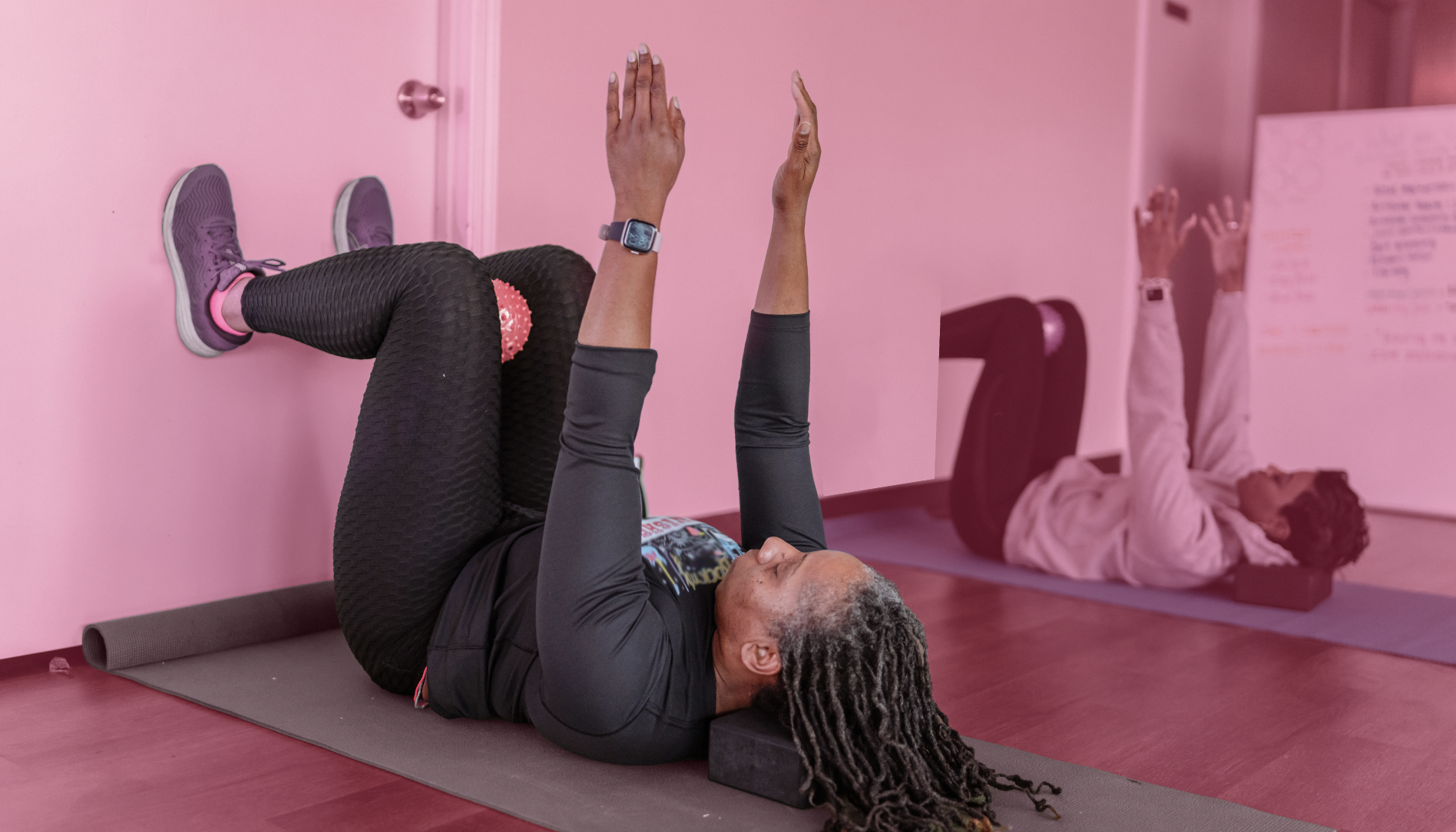
Wall Pilates is a variation of traditional Pilates that incorporates the use of a wall for support and resistance.
Some wall Pilates exercises are done lying on your back with your feet or toes against the wall (e.g., hip raises), and some are done standing or kneeling with your hands or fingers against the wall (e.g., a wall “push-up”).
You might also sit with your back against the wall, using it as a support or guide (e.g., placing your arms against the wall in a goalpost position and sliding them up and down the wall, keeping the backs of your arms in contact with the wall).
Traditional Pilates was created in the 1920s by physical trainer Joseph Pilates as a rehabilitation tool primarily for soldiers returning from war and for dancers. Although it has been around for about a century and continues to be used for physical rehabilitation, Pilates’ popularity as a full-body workout grew significantly in the early 2000s.
More recently, the wall Pilates trend has taken off.
“Wall Pilates is appealing because the exercises are generally more beginner-friendly than traditional Pilates exercises. The wall provides support that helps break down Pilates movements into smaller, more manageable ranges of motion, making it an ideal starting point for many beginners,” said Rachel, from the popular YouTube channel, Rachel’s Fit Pilates.
It can provide similar benefits to traditional Pilates, without expensive equipment or classes, and without the inconvenience and time required to travel to a studio or gym.
Wall Pilates can be done at home with just a mat, a wall, and a free YouTube video, at any time that suits you. “With regular practice over a fairly short period of time, people are experiencing fantastic results, and that has created a buzz online. So, it’s no wonder wall Pilates has become so popular,” Rachel added.
WHAT DOES THE RESEARCH SAY?
All forms of exercise are good for physiological, psychological, and cognitive health, and can help reduce the risk of dementia and cardiovascular disease. Our bodies are meant to move.
So, as a type of physical activity, it’s not surprising that research shows that Pilates is good for us, but in what ways exactly? (Note: the research to date has focused on traditional Pilates, not wall Pilates.)
A recent umbrella review by researchers in China, published in Journal of Science and Medicine in Sport in April-May 2023, looked at the research on Pilates and multiple health outcomes. The researchers found that Pilates offers a number of potential benefits. In particular, they noted that “Pilates can reduce body mass index and body fat percentage, relieve pain and disability, and improve sleep quality and balance.”
However, the researchers also concluded that the quality of the evidence was mostly low, and highlighted the need for more research, using high-quality study design, to confirm these promising findings.
Researchers in India also published a review in 2023 that focused on the effects of Pilates on women’s health specifically. They included ten studies in their review and concluded that practicing Pilates may help improve a woman’s physical and psychological well-being.
Some of the specific potential improvements include improved quality of life and balance, less pain, and increased flexibility, strength, and mobility.
These researchers, also found that the quality of much existing research on Pilates is poor and that additional high-quality research is needed. They shared these findings in Bulletin of Faculty of Physical Therapy.
A 2021 meta-analytic review, published in Frontiers in Neurology, examined the research on Pilates’ benefits for older adults (aged 55+ years). After reviewing the research from 51 studies with a combined total of 2,485 participants, the researchers found that Pilates had a positive impact on the physiological and psychological health of older adults, whether they were healthy or had a pre-existing condition (e.g., chronic low back pain, osteoporosis, diabetes, Parkinson’s, breast cancer).
Small to moderate positive effects were found for these physiological health parameters: muscle strength, balance, endurance, flexibility, gait, and physical functioning. Moderate to large positive effects were found for these psychological health parameters: quality of life, depression, sleep quality, fear of falling, pain, and health perception.
To experience those benefits, participants did Pilates for 12-14 weeks on average in the included studies, mostly two times per week for 60 minutes each time.
“Our review supports the conclusion that Pilates is a promising and safe form of exercise, especially for older adults, even if they have a clinical condition,” said Dr. Lars Donath, senior author of the review and a professor at the German Sport University Cologne’s Institute of Exercise Training and Sport Informatics.
BECAUSE IT IS LOW-IMPACT AND DONE WITH MINDFUL FOCUS, PILATES IS GENTLE ON THE JOINTS AND VERY SAFE FOR PEOPLE OF ALL AGES, INCLUDING OLDER ADULTS.
Some research has focused on just the psychological benefits of Pilates, for example:
A 2024 review, published in International Clinical Psychopharmacology, looked at the effect of Pilates on depressive disorders. Twelve studies were included in the review, and they collectively revealed that compared to inactivity, Pilates can help improve depressive symptoms when it is done over a medium to long period of time (i.e., 8-16 weeks). The effects were found to be comparable to those experienced as a result of aerobic exercise.
A 2018 meta-analysis examined the findings from eight studies of the effects of Pilates on multiple mental health outcomes. Consistent with the findings of the review described in the previous bullet, this meta-analysis found that Pilates interventions were linked with a large reduction in depressive symptoms (11-81%).
In addition, this meta-analysis revealed large reductions in anxiety symptoms (33-46%) and mental fatigue (22.3%). Although these findings were based on a small number of studies with small samples, the researchers concluded that the available evidence “supports that Pilates improves mental health outcomes.” These findings were published in Complementary Therapies in Medicine.
Yet another study of interest is one that was conducted by researchers in Spain who looked at the effects of Pilates on cognitive and physical functioning in postmenopausal women. A total of 110 women aged 60 years and older were assigned to either a Pilates group or a control group. Those in the Pilates group participated in twice-weekly Pilates sessions for 12 weeks, while those in the control group did not receive any intervention.
Participants underwent a series of tests before and immediately after the 12-week intervention period. Compared to those in the control group, women in the Pilates group experienced improvements in verbal fluency, executive function, as well as lower-body strength at the end of the 12 weeks. (These findings were published in 2020 in International Journal of Environmental Research and Public Health.)
So, the answer to the question “Are the anecdotal results being raved about online back up by the research?” appears to be yes (although more research using better-quality study design is needed to confirm the promising findings to date).
IMPORTANTLY, THE RESULTS ARE NOT LIMITED TO JUST PHYSICAL BENEFITS LIKE INCREASED STRENGTH AND IMPROVED BALANCE, THEY ALSO INCLUDE COGNITIVE AND PSYCHOLOGICAL BENEFITS.
WANT TO GIVE WALL PILATES A TRY?
A great way to try out wall Pilates for yourself and stay disciplined long enough to see results is by doing a wall Pilates challenge. A quick online search will reveal many options for this; be sure to look for a challenge led by a certified Pilates instructor (since not all of the people offering these challenges have this important qualification).
Rachel, a certified Pilates instructor and occupational therapist, offers free wall Pilates challenges on her YouTube channel; you can check them out at www.youtube.com/@rachelsfitpilates.
“I currently have two wall Pilates challenges available on my channel; one that’s 28 days and one that’s 14 days. Videos in each of these challenges are fairly short, ranging from about 10-30 minutes per day,” said Rachel. “The 14-day challenge is a great place to start for many people because committing to 14 days can feel less intimidating than 28 days, however both of the challenges are suitable for beginners.”
A challenge certainly isn’t the only way to integrate Pilates into your exercise routine, though. You don’t need to practice daily to experience benefits.
AS THE RESEARCH ON PILATES SHOWS, PRACTICING TWICE A WEEK FOR 50 TO 60 MINUTES (FOR 12+ WEEKS) CAN BE ENOUGH TO PROVIDE PHYSICAL, PSYCHOLOGICAL, AND COGNITIVE BENEFITS.
To get the most out of a Pilates session, it’s essential that you perform each movement with control and precision. If you are brand new to Pilates, you might want to do some in-person sessions with a certified Pilates instructor before trying it at home on your own. That way, you’ll be able to get feedback and learn proper technique to help maximize your results and minimize the risk of injury.
And, if you have any pre-existing health conditions or concerns, you should consult with your healthcare provider before starting a Pilates practice (as is the case before starting any new exercise program).
“Wall Pilates may look easy, but it’s actually quite challenging when done mindfully and with proper form. To maximize strength gains, I like to include dumbbells or a band in some of my wall Pilates videos, although these are optional,” explained Rachel.
“One of the great things about Pilates is that it’s adaptable, and you can increase or decrease the level of challenge based on your current fitness level. It can be gentle enough to be suitable for sedentary individuals and older adults or challenging enough for elite athletes. Wall Pilates really is such an incredible type of physical activity offering so many benefits, I’m not at all surprised by how popular it has become.”
Source: Mind Over Matter V21